
Calculator Says G Cup? Check Your Result Before You Trust It
A surprising G cup estimate is a prompt to check measurements and fit, not a statement about how your body should look.
The result is a starting size, not a final verdict. Read it as three parts together — band, cup letter and system, such as 34G UK. Confirm the band first, then let the symptom decide the next cup move. Confirm the units and system, repeat the tape measurements, and try the calculated band-and-cup combination. Familiarity with an old label is not proof that it fits.
The direct answer
Select the situation that matches you to see the check relevant to this section.
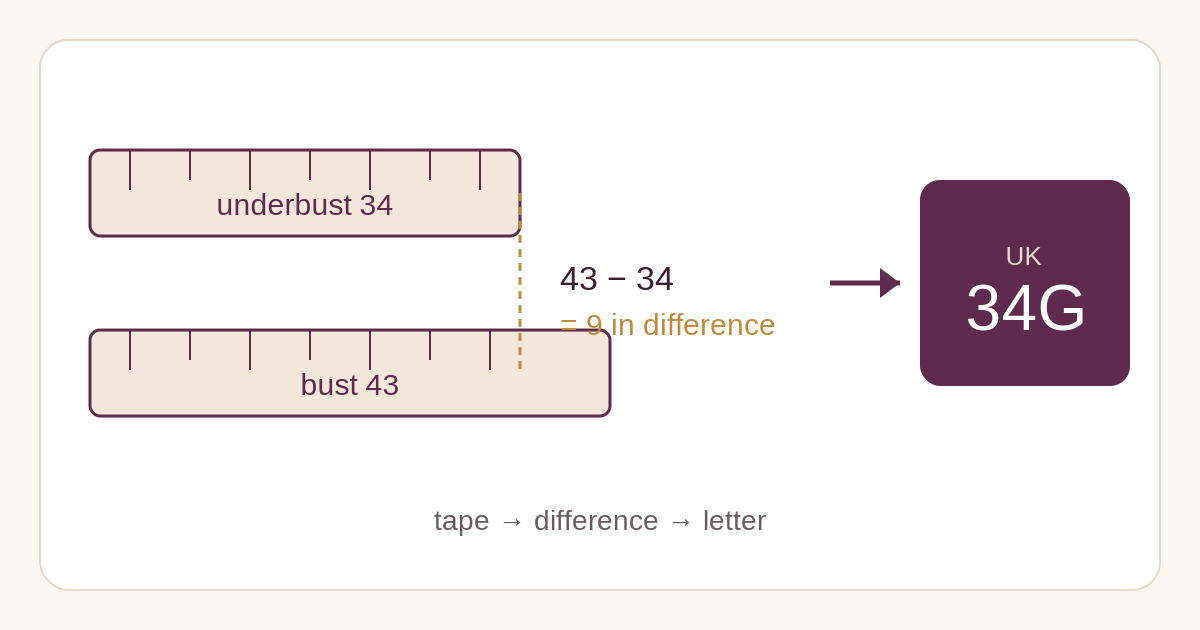
The result comes from two readings: the underbust rounds to the nearest even inch for the band, and bust minus band gives the difference that sets the cup letter — 9 inches is UK G, 7 inches is US G. Treat that combination as a recommended starting size for trying on. Confirm the band first: a band that rides up or digs is a band question, not a cup question.
Then let the symptom decide the next cup move. Spillage points to more cup capacity; gaping with pressure elsewhere points to shape or construction before a smaller cup.
Why the result can differ from your old size
Select the situation that matches you to see the check relevant to this section.
A previous fitting may have used a larger band, a different cup sequence or a limited store range. A snugger band can require a higher cup letter even when your body has not changed.
Some older fittings added inches to the underbust before choosing the band; that produces a larger band and a smaller cup letter for the same readings, so a new result can look like a jump when only the method changed. A different cup sequence has the same effect: a brand that doubles letters (DDD, DDDD) labels the same difference differently from a UK ladder, and a shop with a limited range may have fitted the closest size it stocked rather than the measured one. None of these means your body changed.
Repeat before replacing your wardrobe
Select the situation that matches you to see the check relevant to this section.
Repeat both readings with the same tape, unpadded and level all the way around, and record the unit and the system beside each number. If two repeats disagree, check angle, tension and padding before trusting either one — do not average them away. Then try one or two returnable options first. Compare a seamed construction and a moulded one if the same label behaves differently. If a different tool gives a different answer, see Why do different calculators give different results?.
Two readings taken minutes apart can differ slightly — tape tension, posture and exactly where the tape sits all move the number — and that small variation is normal, not a flaw in the method; what matters is whether the readings agree on the band step, not whether they match to the quarter inch.
Treat community examples as context
Select the situation that matches you to see the check relevant to this section.
Reddit discussions show that surprise and US/UK mix-ups recur. Personal stories can suggest questions to ask, but another person’s successful bra is not validation of your measurements or a guarantee of your fit.
G cup fit problems and what to try next
Select the situation that matches you to see the check relevant to this section.
Before judging any symptom, settle all tissue inside the cups first — often called 'scoop and swoop': lean forward, guide tissue from under the arm and back into the cup, then stand and let it settle. Use the symptom to decide the next comparison, then confirm it in a try-on. For a full diagnosis, use the interactive fit checker linked below this guide.
- Band rides up → band too loose → try a sister size down in band (for example UK 34G → 32GG), cup up to keep volume close; check the band from behind in a mirror, not only from the front
- Gore floats → cup too small, or band too big → try a cup up, or a band down with a cup up
- Spillage over the top or sides → cup too small → try a cup up
- Cups gape → cup too large, or wrong shape/wire width → try a cup down, or a different construction; check shape with the shape-finder
- Straps dig → usually the band is too loose, not a strap problem → check band first before tightening straps
- Straps slip → strap placement, worn elastic, or band fit → adjust, replace, or re-check band
- Wire pokes → wrong wire width or a pattern not graded for a fuller bust → try a different wire width or construction
- One side fits differently → fit the larger side → tighten the smaller-side strap or use a removable pad; do not size the whole bra to the smaller side
- A new brand’s G arrives a cup too small → check that brand’s ladder for FF/DDDD first; on a DDDD ladder the same 9-inch difference reads US H rather than US I, and the brand’s chart wins
Separate a new label from a body change
Select the situation that matches you to see the check relevant to this section.
Moving from a loose band to a more stable band can increase the cup letter while leaving nominal capacity similar. UK 36FF and 34G illustrate that relationship. A higher letter alone therefore does not prove that your body has changed or that the estimate must be wrong.
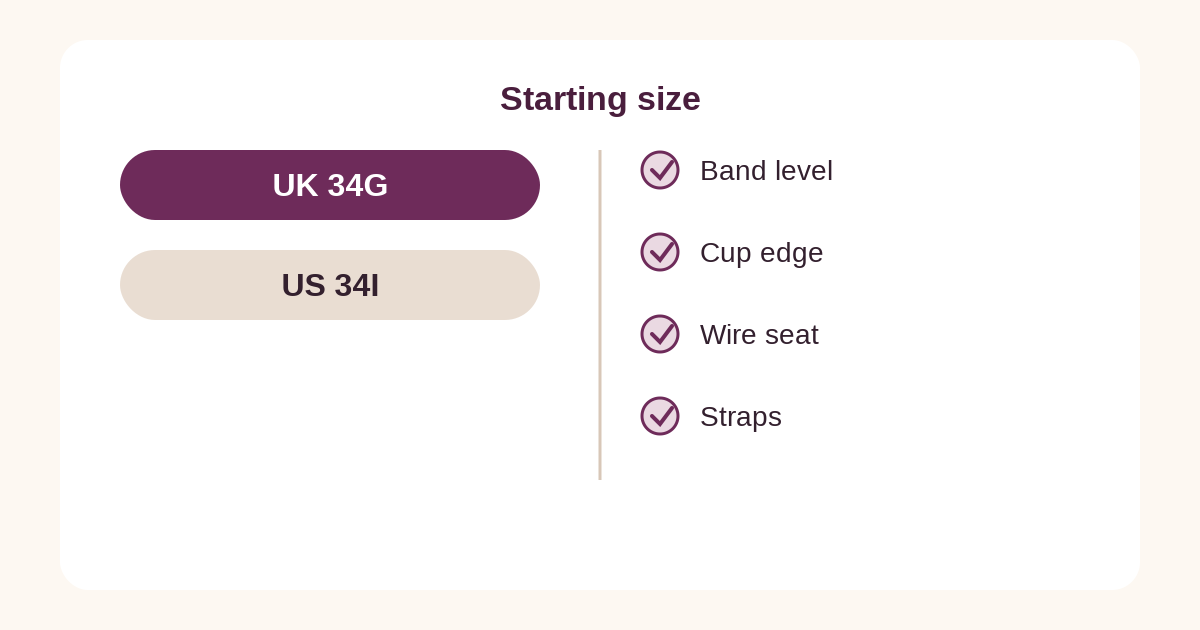
The other common source of surprise is the sizing system: UK 34G and US 34I align on our chart. On a DDDD chart the same 9-inch difference reads US 34H — same difference, different label — so always carry the system with the letter. Looking at the I without its US context makes the difference appear larger than it is. Keep the complete labels beside each other before comparing them.
Make a small, informative first purchase
Select the situation that matches you to see the check relevant to this section.
If you decide to try the result, choose a seller with suitable returns and compare a limited set of options. Keep tags and follow hygiene conditions. Record what happens in the band first, then the cups, instead of buying several unrelated styles at once. A useful first try-on can identify the next change even when the first bra is not the final choice. The fit checker turns one observation from that try-on into the next comparison.
A first size to try
Select the situation that matches you to see the check relevant to this section.
Treat the calculator result as a first size to try on, not a fit guarantee. The returnable-options advice on this page is the method for that try-on: a small, informative first comparison tells you more than a result treated as final.
If a brand’s own chart says something different from the calculator result, follow that brand’s chart for that brand only. A chart disagreement is a chart difference, not proof that your measurements are wrong.
How to interpret your unexpected-size comparison calculator result
Select the situation that matches you to see the check relevant to this section.
Estimate a size, then compare the current UK label’s nominal capacity and band with the new estimate.
A changed estimate explains the model’s inputs; it cannot determine why an earlier bra felt acceptable.
The requested inputs are measured underbust, measured bust, current bra band, current uk cup. Keep the unit or chart context with the result. Blank inputs are not treated as zero, and unsupported values should be corrected rather than used to produce a convenient-looking answer.
Compare the old and new complete labels
Select the situation that matches you to see the check relevant to this section.
Suppose your old bra is 38DD UK and the estimate is 34G UK. Moving from 38DD to 36E and then 34F follows nominal sister-size steps — band down, letter up, volume close. The further change from 34F to 34G is a different operation: it increases cup position on the same band. A letter-only comparison of DD and G hides both operations, so it looks like one jump when it is really two steps of different kinds.
The explanation is different if the reported G is US rather than UK. Write the old and new labels down in full — band, letter and system — before attributing the surprise to a size jump. Your previous garment may also have been selected from a limited range; familiarity is evidence of what you wore, not independent evidence of fit.
Use one returnable try-on to investigate the estimate rather than replacing everything immediately. If a new size contains more comfortably but its mould leaves space at the top, compare construction before rejecting the entire size. Record the specific result so a fitting conversation can address it.
Unexpected-size comparison calculator
Enter the requested information to get a result for this question.
Your unexpected-size comparison calculator result
How this tool reaches its result
Estimate a size, then compare the current UK label’s nominal capacity and band with the new estimate.
A changed estimate explains the model’s inputs; it cannot determine why an earlier bra felt acceptable.
Site calculation methods →For a full diagnosis
Use the interactive fit checker to work through gaping, spillage, wires and band comfort step by step.
Common questions
How can a smaller band explain part of a jump from DD to G?
Which complete labels should I compare side by side?
What does an estimated size leave unanswered?
Sources & method
These named references informed the chart or fit guidance. Find publisher details and source locations in our source register. Worked examples use our documented independent method; they are not product tests or fit guarantees.
Found a chart mismatch or unclear explanation? Tell us which page and sizing system.