
Why G Cup Bra Size Calculators Disagree — and What to Try First
Different ladders, rounding rules and tape methods can give different G cup answers from the same measurements. Here is how to read the disagreement.
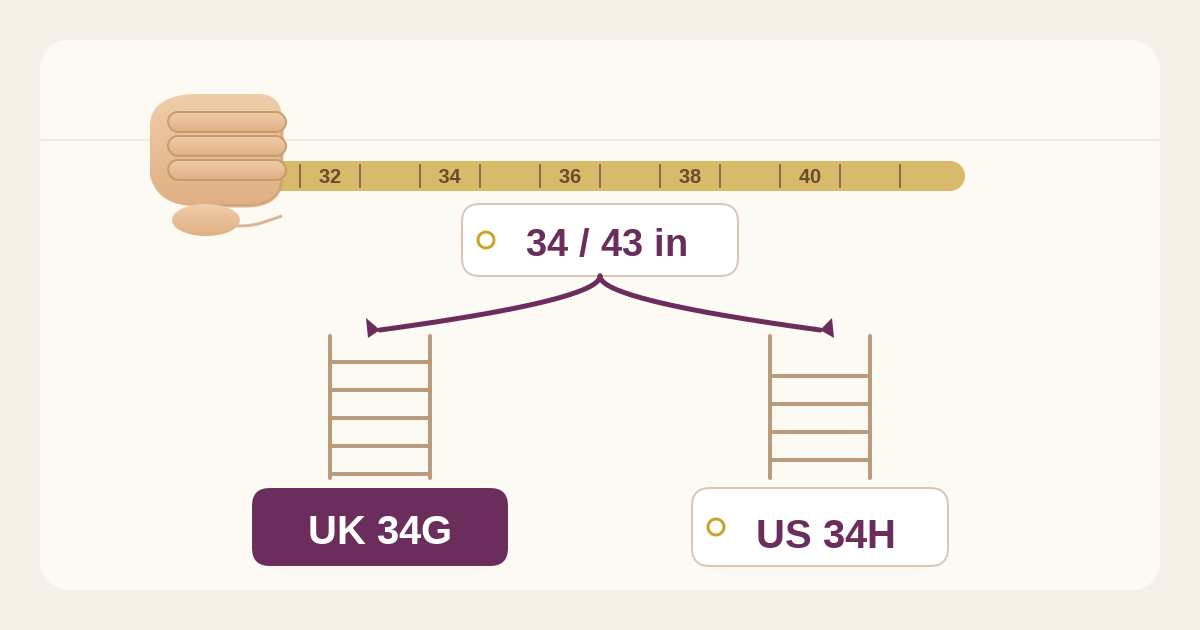
Two G Cup Bra Size calculators can take the same two measurements and return two different sizes, and neither has necessarily made an arithmetic mistake. A bra size is not a single physical measurement. It is a label produced by a method: a chart, a rounding rule and a way of holding the tape. Change any one of those, and the label can change while your body stays exactly the same.
The useful question is therefore not “which calculator is right?” but “what method produced this answer, and what should I try first?” This post works through the three reasons calculators disagree — the ladder, the rounding rule, and the tape — and then shows how to use them, using only the ladder logic this site itself uses, so you can compare any outside result against it.
The ladder is usually the biggest reason
The largest disagreements come from the cup ladder, not from your measurements. In the method used here, the band is the underbust rounded to the nearest even inch, and the cup comes from bust minus that band. A 9-inch difference is a UK G, and a 7-inch difference is a US G. That is why the same 34-inch underbust and 43-inch bust gives UK 34G and US 34I on the common ladder used here: 43 minus 34 is 9 inches, and 9 inches is G in the UK system and I in the US system.
Other charts insert extra steps. Some US charts, including HauteFlair’s, insert an extra DDDD step after DDD, so on those charts UK 34G reads US 34H instead of US 34I. The 9-inch difference is the same; only the label differs. Neither chart is “wrong” — they are different naming systems for the same difference. A calculator that does not say which ladder it uses cannot be compared with one that does, so always check the chart before comparing two answers.
Rounding and the band step change the answer too
Even on the same ladder, rounding can move the result by a full band. This site rounds the underbust to the nearest even inch, with exact odd-inch ties rounding upward, and then subtracts that rounded band from the bust. An underbust of 33 inches therefore gives a 34 band, while a value just below 33 gives a 32 band. Because bands move in two-inch steps, a measurement a fraction of an inch either side of a boundary can produce a different starting size.
A calculator that subtracts the raw underbust instead of the rounded band, or one that adds inches to the underbust before calculating, will give a different answer from the same inputs. That does not mean one of them measured you incorrectly; it means they applied different rules to the same numbers. When two results differ by one band, check whether the band or the cup is the part that moved — a band difference and a cup difference are different problems with different try-on answers.
Tape placement and the method behind the number
The third reason is the measurement itself. A tape that sits diagonally, rides up at the back, or compresses tissue does not follow the same path as a level tape, and a bust measurement taken at a different point gives a different difference. This site’s method keeps it simple on purpose: a snug, level underbust immediately below the breast tissue, and a full-bust measurement at the fullest point without compressing tissue, recorded in the units you actually measured in.
Some calculators add extra measurements, such as a leaning bust measurement, and then average several figures together. The leaning measurement on this site’s step-by-step measuring guide is offered only as a comparison check, attributed to bra-calculator.com, and it is never averaged into the result — guides vary on the lean angle, so no single angle is the rule. If a calculator averages your measurements without saying so, its answer will sit between your readings and match none of them exactly.
The entities behind every answer: band, cup, difference, system
It helps to name the parts, because a calculator disagreement is almost always a disagreement about one part, not about all of them. The underbust measurement is a length around the ribcage, taken immediately below the breast tissue. The band size is what that length becomes after a rule is applied — here, rounding to the nearest even inch. The bust measurement is a length at the fullest point. The difference is bust minus band, in inches. The cup letter is what that difference becomes inside a particular sizing system. And the system — UK, US, EU, French, Australian, Japanese export — is the naming convention that turns a difference into a letter.
Each relation matters. The band relation decides the frame: a different band means a different frame, even if the cup letter stays the same. The difference relation decides the cup: the same difference always means the same cup step inside one system, but a different letter in another system. The system relation decides the label: UK G, US I, EU I and the other labels in this site’s size converter can all describe the same 9-inch difference on a 34 band. When you see two calculators disagree, ask which relation they handled differently. If they used the same band rule and the same difference but different systems, the disagreement is only a label — the what-is-a-G-cup guide explains that relation in full. If they used different band rules, the disagreement is about the frame, and the try-on will feel different. If they measured different points, the disagreement is about the inputs, and no ladder can resolve it.
The EU, French, Australian and Japanese labels work the same way, as relations rather than as separate sizes. On this site they are label equivalents of the UK starting estimate within the Freya chart’s published range, and the Japanese result is explicitly an export-chart label, not a Japanese domestic measurement formula. That distinction is the point: a label system does not change your measurements, it only renames the result. A calculator that presents an EU or Japanese label without saying which chart it came from is hiding the relation you need in order to compare it with anything else.
Why the same tape gives two labels in different shops
A shop adds one more relation: the display label versus the garment label. A shop may display converted labels in its selector while the garment itself carries the brand’s original system, or it may display the brand’s system while you are thinking in your own system. The UK-versus-US worked example follows a UK 34G label through a US storefront step by step, and the confusion it shows is exactly this: the shopper selected what looked like the right label, and the garment arrived in a different system.
This is where the DDDD ladder earns its warning, as the ladder section above explains: a calculator built on one ladder and a shop built on the other will disagree by one cup letter while agreeing on every measurement. The fix is not to decide which ladder is “correct” in the abstract — both are naming conventions — but to name the ladder before you order, and to check the tag on the garment when it arrives. If the tag system differs from the selector system, the disagreement was never about your body at all.
The same numbers through four brand methods
The ladder difference is easier to see worked than described. Take one pair of measurements — a 34-inch underbust and a 38-inch bust — and run them through four named methods, as reported in the Bra Atlas piece “One tape measure, four bra sizes” (runs dated 25 September 2026):
| Method | Band rule, as reported | Result for 34 in underbust, 38 in bust |
|---|---|---|
| Measured-band method (this site’s ladder) | Band is the underbust rounded to the nearest even inch | 34D |
| Wacoal’s calculator | Band is the underbust +2, or +3 if odd | 36B |
| ThirdLove’s calculator | Rule not stated in the piece | 36A |
| SKIMS chart | Band +4 | 38A |
Every brand answer has a bigger band and a smaller cup letter than the measured one — that is the point the table makes. The Bra Atlas piece cites White & Scurr (2012, Ergonomics, 45 women) for the +4 method overestimating the band and underestimating the cup. Brand tools change, so this table shows how the methods differ, not a live verdict on any brand’s current tool: compare the rule behind any result you are given, not the label alone.
One cup apart: when to trust it, when to re-measure
Many calculator disagreements are one cup or one band apart, and that size of disagreement has a useful reading. One cup apart, with the same band, usually means a rounding boundary, a tape-position difference, or a ladder difference — in other words, a rule difference, not a measurement disaster. Try the starting size from the method you can see most clearly, and let the fit checker arbitrate from the try-on. When your numbers sit close to a line, name the neighbouring size as well — the size one step away in the direction the numbers lean — and why it is worth trying: the neighbour is a display of the next comparison, not a second answer, and the try-on still arbitrates.
Re-measure instead when the disagreement is larger, when the two results differ in both band and cup at once, or when you cannot reconstruct how either answer was produced. Re-measuring means returning to the step-by-step measuring guide: a level underbust immediately below the tissue, a full-bust measurement at the fullest point without compressing tissue, recorded in the units you actually measured in. Do not average the two calculator answers together, and do not average several bust readings together — averaging hides the rule that caused the disagreement instead of revealing it. The leaning measurement stays a comparison check on this site, not an input to the result. If a calculator’s leaning figure changes your answer, that calculator is using a different method, and you should compare methods, not split the difference between results.
A checklist for comparing any two calculators
Before you trust either answer, ask five questions. Which sizing system and ladder does it use — common US, DDDD, UK, or something it never names? Does it round the underbust to an even band, use the raw underbust, or add inches to it? Does it subtract the rounded band or the raw measurement to get the difference? Does it average several measurements, or use one underbust and one bust figure? And does it show its tape instructions, or only a result box? A calculator that answers all five transparently can be compared with this site’s method directly; one that answers none of them cannot be compared with anything, however confident its result looks. Keep the answers next to the results when you try garments on, because the try-on will tell you which method described your fit — and that is the method worth using next time.
What to do with two different answers
Start with the answer whose method you can see. If one calculator shows its chart, its rounding rule and its tape instructions, and the other shows only a result, the transparent one is the better starting point — even if the other one gave you the answer you expected.
Then treat the result as a starting size, not a verdict. Try the band first: it should feel snug and level on the loosest hook, because a band that rides up or slips will make every cup judgement unreliable. Then work through the fit checker with the actual garment on, and use the size converter when the disagreement is about labels rather than fit. If the two answers differ only by system — UK G against US I, for example — that is a labelling difference, and the UK-versus-US worked example shows how to follow it through a shop’s own selector.
A calculator disagreement is usually information, not failure. It tells you which rule, ladder or tape position is doing the work. Once you can name that, you can choose the starting size to try on — and the try-on, not another calculator, is what settles it.