
G Cup Size in CM and Inches: Bust and Band Measurements
Explore how a G label changes with the band and whether you mean UK G or US G. Read it in two moves: change the band and you move to a new row; change the system and the same row gives a different bust reference.
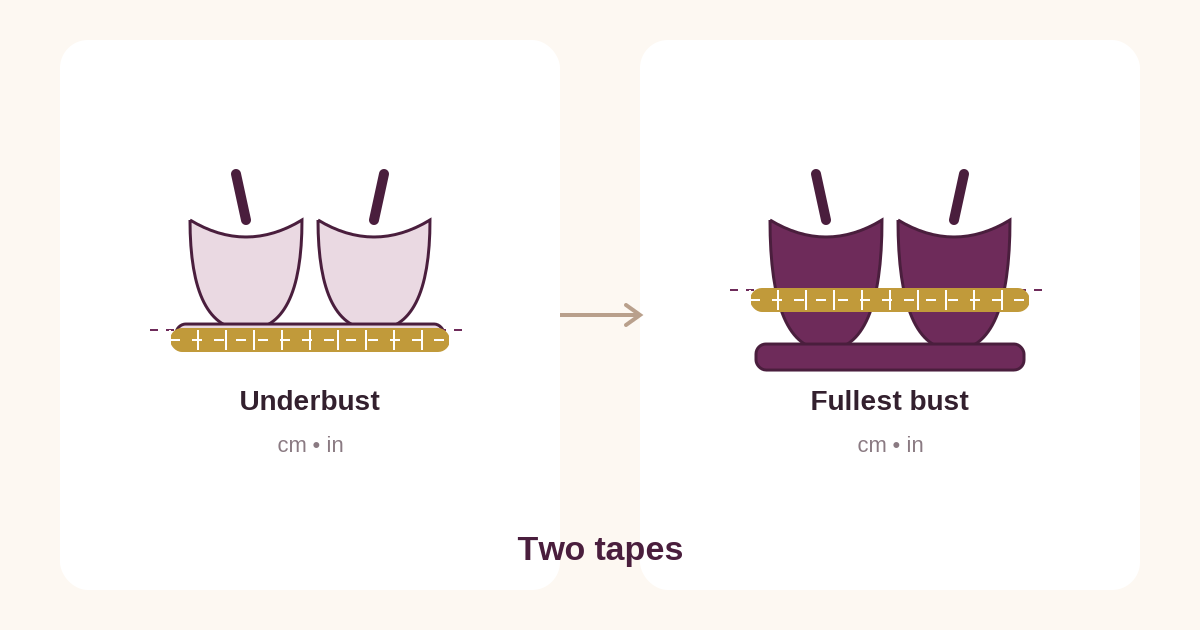
Under this site’s simplified band-difference method, UK G uses a 9-inch (22.86 cm) difference and US G uses 7 inches (17.78 cm). These are model references, not universal brand ranges. Start from your underbust rounded to the nearest even inch; the bust reference is that band plus the difference.
Explore G cup measurements
Starts with a labelled example. Change the inputs below to calculate your own comparison.
See the band reference and bust reference
Changes with the inputs above. This is a garment and label diagram, not a body prediction.
Freya international size chart · Method and limitations. Size labels do not guarantee fit or stock availability.
Do your readings match the G size you selected?
Choose a reference band and label system. Compare your own measurements with that specific G label in our documented model. This is a reference check, not a fit guarantee.
Enter your two readings to compare with the selected complete G size.
Bars compare the entered lengths, not body shape. Use the homepage calculator for the full international result and measurement guide.
| Complete reference | UK G bust model | US G bust model | UK adjacent sisters |
|---|---|---|---|
| 28G | 37 in / 93.98 cm | 35 in / 88.90 cm | 26GG / 30FF |
| 30G | 39 in / 99.06 cm | 37 in / 93.98 cm | 28GG / 32FF |
| 32G | 41 in / 104.14 cm | 39 in / 99.06 cm | 30GG / 34FF |
| 34G | 43 in / 109.22 cm | 41 in / 104.14 cm | 32GG / 36FF |
| 36G | 45 in / 114.30 cm | 43 in / 109.22 cm | 34GG / 38FF |
| 38G | 47 in / 119.38 cm | 45 in / 114.30 cm | 36GG / 40FF |
| 40G | 49 in / 124.46 cm | 47 in / 119.38 cm | 38GG / 42FF |
| 42G | 51 in / 129.54 cm | 49 in / 124.46 cm | 40GG / 44FF |
| 44G | 53 in / 134.62 cm | 51 in / 129.54 cm | 42GG / 46FF |
| 46G | 55 in / 139.70 cm | 53 in / 134.62 cm | 44GG / 48FF |
| 48G | 57 in / 144.78 cm | 55 in / 139.70 cm | 46GG / 50FF |
| 50G | 59 in / 149.86 cm | 57 in / 144.78 cm | 48GG / 52FF |
Read the chart as a worked example
Select a band, sizing system and unit to see the same model in inches or centimetres. The band is a label; its numerical conversion into centimetres is not automatically the same as an EU band label. If your reading falls between two rows, re-read with the same tape, unpadded and level, round the underbust to the nearest even inch, and read that row — then try that row on rather than averaging two rows.
Why a single G cup circumference is misleading
On a nominal 32 band, UK G gives a 41-inch bust reference. On a 38 band, the same UK cup letter gives 47 inches. The letter describes a relative position rather than one circumference for everyone. A chart that lists one G circumference without a band or a system is missing the two facts that fix the reference.
The full difference ladder, bust minus band: 1 inch — A; 2 inches — B; 3 inches — C; 4 inches — D; 5 inches — DD; 6 inches — DDD (US) / E (UK); 7 inches — G (US) / F (UK); 8 inches — H (US) / FF (UK); 9 inches — I (US) / G (UK); 10 inches — J (US) / GG (UK); 11 inches — K (US) / H (UK). On a 34 band that puts UK G at a 43-inch bust and US G at a 41-inch bust — the same numbers this page already uses.
The EU method steps one letter per 2 cm of difference under EN 13402: 24–26 cm of difference is a G. The centimetre ladder is calculated independently from the inch ladder, which is why the same body can get a different starting label from each method.
Use a garment chart before buying
Brands may use body-measurement tables that differ from our estimate. Keep that method separate from a label-conversion chart. Use the output as a reference and assess the actual bra after trying it on. When a garment chart disagrees with this one, keep the name of the garment chart with your result and let the garment chart win for that garment.
Inches, centimetres and band labels are different
The numerical length of 34 inches is 86.36 cm. That does not make the garment an EU 85 or EU 86 band: on the Freya label chart, UK 34 aligns with EU 75. A unit conversion changes how a length is written; a regional chart translates the label on a garment. Keep those operations separate. So read a centimetre column as a length, and an EU column as a label — never convert one into the other by multiplying.
The same band in seven label systems reads: US 34 = UK 34 = EU 75 = FR 90 = IT 2 = AU 12 = JP 75. France and Spain add fifteen to the EU number, and Italy counts 1 to 6. The row is a label translation, not a length conversion — the IT, AU and JP columns name the label on the garment, not a measurement. (HauteFlair conversion page; EU 75 cross-checked against the Freya chart this page already cites.)
For a UK 34G reference in our model, 43 − 34 = 9 inches. For US 34G, 41 − 34 = 7 inches. Neither calculation describes the appearance of the wearer, and neither establishes a universal measurement range for all products marked G.
Read a manufacturer’s body chart on its own terms
Some charts ask for an underbust interval and a bust interval; others provide a labelled conversion for an existing size. Read the column headings before applying a formula. If a manufacturer’s method gives a different starting point, record the method alongside the result and verify the garment through a try-on. Note whether the chart gives intervals (a range of readings per row) or single model points like the table on this page: an interval chart and a point chart will not agree row for row, and that disagreement is a method difference, not proof that either reading is wrong.
Two honest methods can disagree
The EU centimetre method is calculated independently from the inch method, not converted from it: centimetre underbust rounded to 5, with centimetre cup steps. The same body can therefore get a different starting label from each method, and that disagreement is a method difference, not a measuring error. Keep the method with the saved result, and use the garment’s own chart before buying.
Work through the UK and US measurement references
Select band 36 and UK sizing. The chart adds the UK G reference difference of 9 inches to the nominal 36 band, giving 45 inches or 114.30 cm. Change only the system to US and the G reference difference becomes 7 inches, giving 43 inches or 109.22 cm. The cup letter looks unchanged, but the declared system changes the reference. On a DDDD chart the same 9-inch difference reads one letter lower in the US column (US H where this chart shows US I) — same difference, different label.
Next hold UK G constant and change band 36 to 38. The worked bust reference becomes 47 inches. This is the clearest reason not to answer “What is G cup in cm?” with one isolated circumference. The question needs both a band and a system. The chart’s value is a model example rather than an interval promised by every manufacturer.
Use the chart beside, not instead of, your measurements
The selected band is a label. Your measured underbust may round to it under this site’s rule, but a brand can apply a different fitting method. Do not replace your raw tape reading with the band number and then describe that substituted number as a measurement. If two repeats give different rows, check angle, tension and padding before trusting either row — do not average the two rows into a middle size. The measuring guide shows the tape path and tension behind each reading.
If you are deciding between UK 34G and 36G, the chart demonstrates different references. If you need a larger band with similar nominal capacity to UK 34G, use the sister-size tool for 36FF rather than retaining G. If you already have a comfortable size and need an EU label, use conversion rather than multiplying the band label by 2.54. For why the letter itself differs between systems, see what a G cup is.
Look up 28G through 50G without changing the method
Select the band in the interactive chart to see its references, then use the reading check to compare your own measurements with that complete G label. The table gathers all twelve band references in one place so you can compare rows without opening repetitive pages. Start from your band row, then read across in your system; changing only the system changes the reference without changing your readings.
These bust values come from the documented model. They are not physical garment dimensions or universal manufacturer fit intervals. UK and US G use different cup positions; keep the selected system with the result. International label conversions above UK band 44 remain outside the Freya chart used here. Rows above UK band 44 are model extensions of the same arithmetic, not Freya chart rows — keep that distinction with the result.
Common questions
Where should I start with g cup measurements?
What does g cup measurements leave for an in-person try-on?
Sources & method
These named references informed the chart or fit guidance. Find publisher details and source locations in our source register. Worked examples use our documented independent method; they are not product tests or fit guarantees.
Found a chart mismatch or unclear explanation? Tell us which page and sizing system.