
G Cup Bra Size Equivalent: Convert UK, US and EU Sizes
Translate a complete size across a named international chart — UK, US, EU, France, Australia and Japan labels — by holding the band and the inch difference steady and re-lettering the cup in each system.
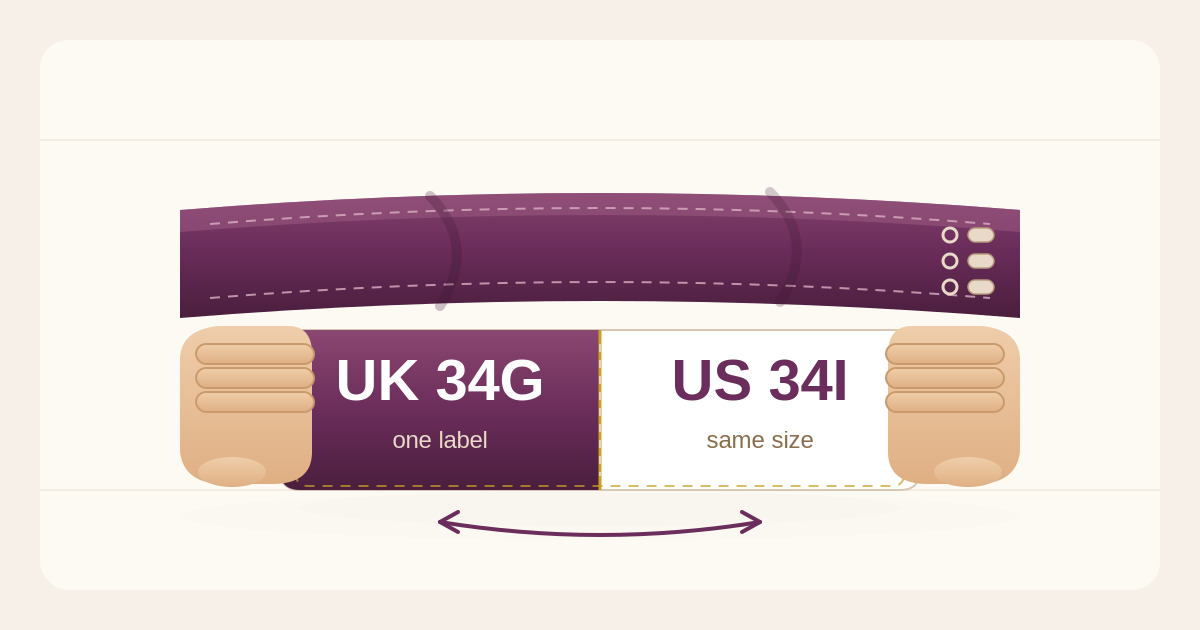
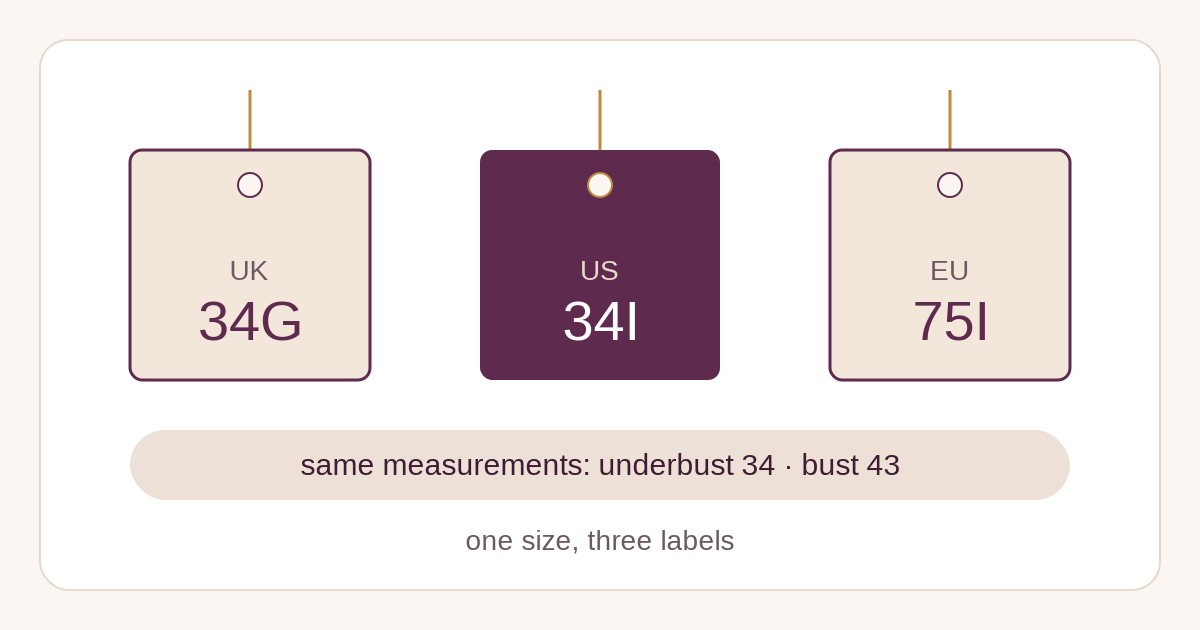
In the Freya chart, 34G UK maps to 34I US, 75I EU, 90I France, 12G Australia and 75J Japan. This is a chart-specific label mapping, not a universal truth: on a chart that inserts DDDD after DDD, the same UK 34G reads US 34H — the 9-inch difference is the same, only the label differs. Always start from the system actually printed on the label in front of you.
International size converter
Starts with a labelled example. Change the inputs below to calculate your own comparison.
Watch the label change between systems
Changes with the inputs above. This is a garment and label diagram, not a body prediction.
Freya international size chart · Method and limitations. Size labels do not guarantee fit or stock availability.
| System | Worked example |
|---|---|
| UK | 34G |
| US | 34I |
| EU | 75I |
| France | 90I |
| Australia | 12G |
| Japan | 75J |
| US, DDDD chart | 34H |
Why the band numbers differ
EU bands are the underbust in centimetres, in 5 cm steps; FR/ES bands add 15 to the EU number; AU bands use dress-size numbers; IT counts 1–6 instead of a circumference. Read the table with that logic: 34 → 75 → 90 → 12 is one band in four numbering systems, not four different bands.
A size "does not travel" for three separate reasons — band units, cup ladder, and the brand's own cut. The band numbers above are the units; the cup letters differ because the UK ladder spends extra steps on doubled letters while the US ladder stacks DDD and then moves on; and the cut is the brand's own, which no conversion can predict.
Some Polish brands step cups by 2cm, so a size can fall between two UK letters — use that brand's own chart.
Select the source system first
The label on a product page may reflect the storefront’s region, not the brand’s home system. Check the system actually displayed before selecting US or UK — and convert the whole label, band and cup together. A bare letter cannot be converted: G alone is 9 inches on the UK ladder and 7 inches on the common US ladder, so converting the letter without its band and system is how a UK G becomes a US G by mistake. Running the conversion backwards gives a different starting label, not the same one in reverse: 34G US follows the same chart to 34F UK.
Supported chart boundaries
The published Freya chart used here covers UK bands 28–44 and cups B–K. Outside that range the converter refuses rather than inventing an extrapolation: a refused combination is a statement about this chart, not about whether the size exists. Do not work around a refusal by picking the closest-looking label — find a chart that explicitly includes the size.
Conversion is not a new measurement
A label converter aligns labels in a particular manufacturer chart. It does not remeasure your body, establish equal fit across brands, or turn one brand’s label into another brand’s fit. The inch difference is what travels between systems: 9 inches reads G on the UK ladder and I on the common US ladder because the UK ladder spends extra steps on doubled letters (DD, FF) while the US ladder stacks DDD and then moves on. EU and Japanese band numbers are centimetre figures with their own rounding — a 34 band maps to EU 75 — not inch bands converted into centimetres, so do not rebuild a body measurement by converting an inch band number.
A cross-border shopping example
Suppose your well-fitting Freya bra is 34G UK and a US retailer displays converted US labels. The chart alignment is 34I US. Selecting 34G US would not preserve that cup position. Conversely, a wearer starting from 34G US follows the same chart to 34F UK. If that US retailer uses a DDDD sequence, the same UK 34G appears as 34H instead — check the sequence on the retailer’s chart before concluding the converter is wrong. The reason the same letter sits at different positions is explained in the G cup guide.
Check whether the storefront already translates its sizes. The brand’s country of origin does not automatically determine the labels shown by every retailer. Keep a note of both source and target labels, and when there is a conflict use the seller’s actual product chart: the chart that belongs to the garment wins over this converter.
What to do with an unsupported label
A label such as a US F may be an alias in a brand-specific sequence, but the supported US ladder used here puts DDD at that position. Do not choose the closest-looking option simply to get an output: a plausible-looking label is not an equivalent label. Find the brand’s cup sequence or ask the seller which chart applies.
The published chart boundary limits this converter, not the existence of fuller-bust sizes. For a 46 band or another unsupported input, use a manufacturer’s chart that explicitly includes the size, and keep that chart’s name with your result. Japanese labels follow two separate paths, so the Japanese sizing guide keeps the body chart and the export labels apart.
Read a full international result from left to right
Start with source system UK, band 34 and cup G. On the named Freya chart, the aligned labels are US 34I, EU 75I, France 90I, Australia 12G and Japan 75J. Each target represents a printed label mapping in that chart. It does not mean that every product carrying one of those labels has identical dimensions. Read the result as one full label at a time, band, letter and system together, because a letter without its system is not a size: the same 9-inch difference that gives UK 34G reads as US 34I on that Freya chart, and as US 34H on DDDD charts.
Changing the source to US while retaining 34G describes a different starting label. Its UK alignment is 34F. The direction of conversion matters because G does not occupy the same position in the two ladders. The live diagram displays the input label, the source chart and the output together so the context remains visible. Convert first, then compare inside one system: stacking a system change and a band change into one move hides which change mattered, and a converted label is a starting size to try on, not a guaranteed fit.
Resolve a conflict between a shop and this converter
Check whether the retailer has already converted the brand’s original labels. Then check that the chart belongs to the actual product range. If the maker uses a different sequence or an alias, follow the product-specific explanation rather than choosing the closest-looking option in this tool. When the shop chart and this converter disagree, state which chart the result follows rather than averaging the two: an average of two labels is a third label neither chart supports.
The supported chart contains UK bands 28–44 and UK cups B–K. A value outside those limits is not evidence that the size cannot exist; it means this source does not establish its equivalent. Use a chart that includes the complete size and retain its name with your result. Do not use a conversion to justify a sister-size move, or the reverse: conversion relabels the same measurements in another system, while sister sizing changes the band and keeps the volume. Keep the chart name with the result, and check the garment’s own chart and a try-on before ordering: a converted label organises the comparison, but only the try-on shows whether that particular garment fits.
UK 34G — 9-inch bust-to-band difference on the UK ladder.
Some US charts label this size US 34H instead. Check the chart used by the seller; a different label does not automatically mean a different garment.
Common questions
Where should I start with g cup bra size conversion?
What does g cup bra size conversion leave for an in-person try-on?
Sources & method
These named references informed the chart or fit guidance. Find publisher details and source locations in our source register. Worked examples use our documented independent method; they are not product tests or fit guarantees.
Found a chart mismatch or unclear explanation? Tell us which page and sizing system.