
UK G vs US G Cup: Why the Same Letter Is a Different Size
UK 34G is usually US 34I, but some US charts call it 34H. Work through one real example and see which label your chart is using before you order.
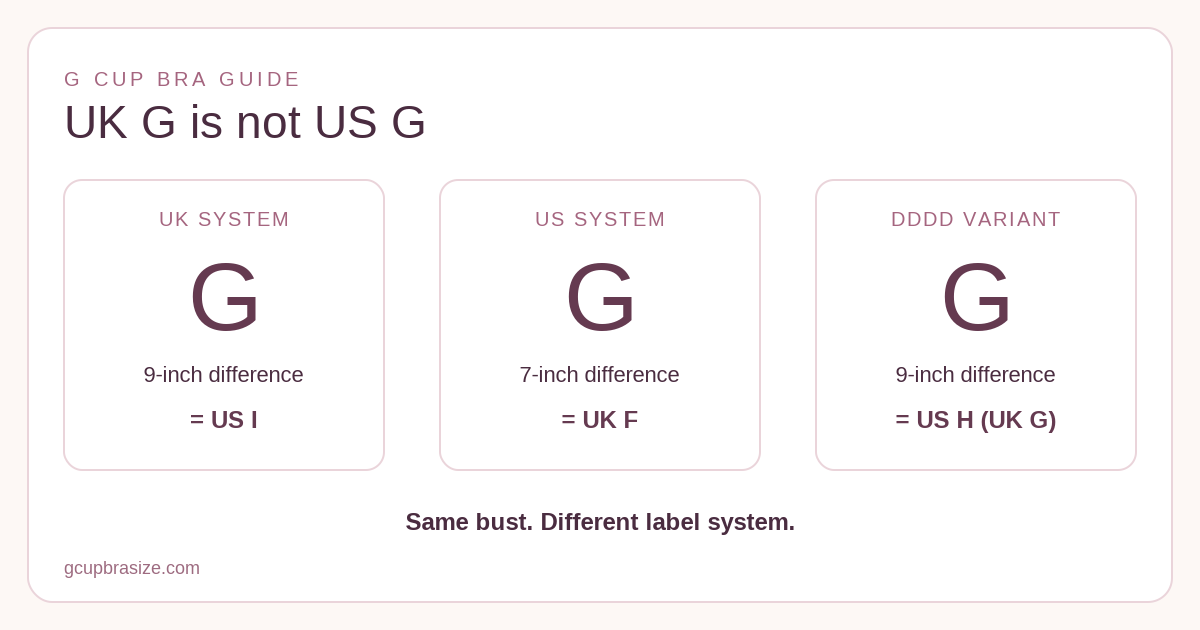
The short version: a UK G cup is a US I cup, not a US G cup. The rest of this post works through why.
You have a comfortable bra labelled 34G UK. A US shop offers the same brand and displays a G option. It is tempting to select it and move on, but one question changes the order: has the shop converted the sizes into US labels, or is it displaying the brand’s UK labels? The reason the same letter can mean two different cups is the sequence, not the garment: above DD the UK sequence inserts double letters, so UK G sits at a 9-inch difference while the common US G sits at a 7-inch difference — two steps apart on the same band. That is why a G Cup Bra Size label is never complete without its system.
This worked example follows the Freya international chart. It is a label comparison, not a claim that every brand grades its garments identically.
First, identify the selector’s system
Read the size guide attached to the specific product. A UK brand sold in the United States does not necessarily appear under US cup labels. The storefront can preserve the original labels or provide converted ones. Its currency and shipping country do not answer that question.
On the chart used here, 34G UK aligns with 34I US. If the selector explicitly uses US sizes, I is the aligned cup label for this example. If it explicitly uses UK sizes, G remains the relevant label. Converting a size that the retailer has already converted would introduce another error. One variant to watch for: on charts that use a DDDD step, the same UK 34G aligns with US 34H instead of 34I, so read the brand’s own chart before assuming the I alignment.
US sizing is not fully standardised — on some US charts DD is also labelled E and DDD is also labelled F — so a US label alone does not prove which ladder the chart uses; read what follows DD on that brand’s own chart. A quick tell: look at what follows DD on the brand’s own chart — DDD means US labels, E means UK labels; if the brand’s chart disagrees with the chart used here, the brand’s chart wins.
Keep conversion separate from availability
Suppose the aligned size is missing but 36G appears in stock. It has a different band, and retaining G in the same system also changes nominal cup capacity. It is not an equivalent label for the original garment.
For UK 34G, the adjacent larger-band sister size is 36FF UK. That relationship preserves similar nominal capacity while changing the frame. It still does not guarantee an acceptable fit. If the original 34 band is already comfortable, moving to 36 only because it is available may solve the stock problem while creating a support problem. And do not combine the two moves at once: convert first, then sister-size inside the converted system — picking a US 36G as if it were the sister of UK 34G changes the band and drops two cup steps at once, so it is neither a conversion nor a sister size.
Check the order and the garment
Save the product’s displayed system with the order details. When it arrives, compare the garment tag with the product chart. Multiple regional labels on a tag can help explain why the order confirmation and the familiar UK label look different.
Then try the bra. If it is a new model, the matching label cannot promise the same wire width, cup depth or neckline as your existing bra. Settle tissue into the cups, assess the band, and repeat the fit check after sitting and reaching. Check the band first, then containment, then wire and straps — one observation at a time — and record the full label, band, letter and system together, with the observation, so a later try-on can be compared on the same terms. Follow the retailer’s current hygiene and return conditions while deciding whether to keep it.
Use the full size converter for all supported regions and the comparison tool when both the band and cup differ. The methodology explains the chart boundaries and why conversions cannot predict a perfect fit. A letter without its system is not a size at all: keep the system attached to every label you write down.