
How G Cup Bra Sizes Work: Two Numbers, One Letter, No Fixed Size
A bra size is two measurements, not one fixed size. Learn what the number and the letter each mean, why the same letter changes with the band, and why UK, US and EU labels part ways.
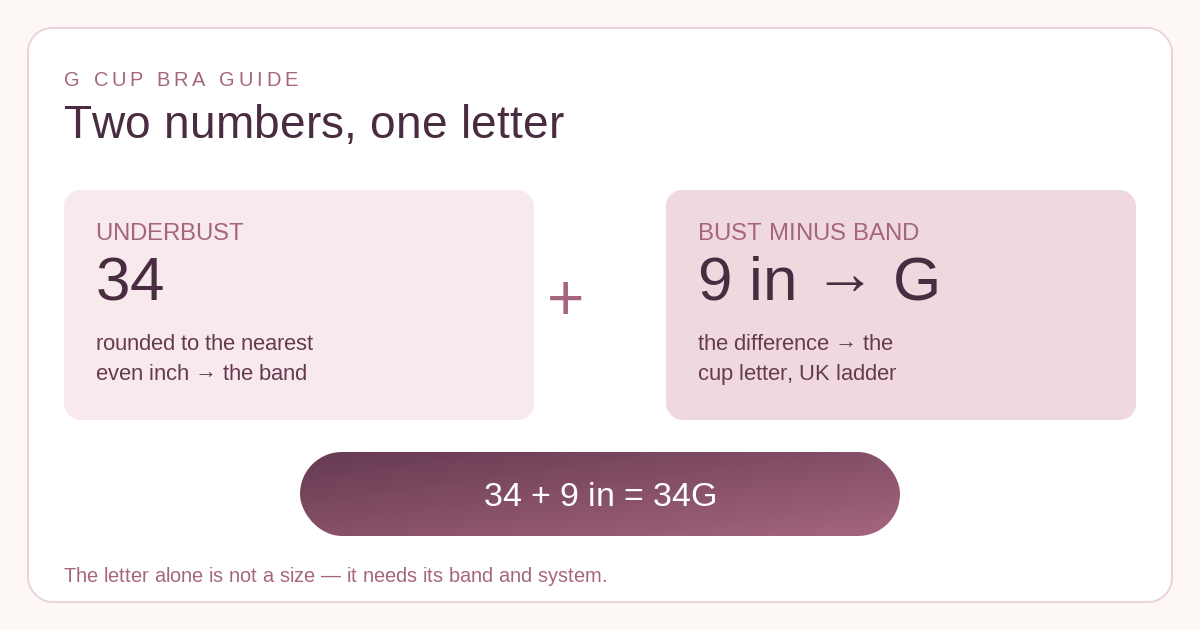
A bra size looks like a single label — 34G, say — but it is really two measurements joined together. Once you know what each half means, a lot of sizing confusion clears up on its own. This post works through the system from the beginning, so you can read any size label and know what it is actually saying.
Three misunderstandings, corrected up front
Before the details, here are the three mistakes that cause most of the trouble:
- The letter is not a fixed size. G does not mean one set volume. The same letter holds a different volume on every band, because the letter only describes a difference, not a measurement on its own.
- The number is not a shoulder size or a clothing size. The number is your band, and it comes from one measurement only: your underbust. It has nothing to do with dress sizes or shoulder width.
- The same letter on a different band is a different volume. 32G, 34G and 38G are not the same cup in three band lengths. As the band grows, the cup volume grows with it, even though the letter stays the same.
Keep those three in mind and the rest of this post will feel straightforward.
The number: your band
The number in a bra size is the band, and it comes from your underbust measurement — the measurement taken around your ribcage, directly under your bust. Round that measurement to the nearest even inch, and that is your band. Nothing is added to it.
That last point matters. Some older advice tells you to add inches to your underbust before choosing a band. Do not do that: adding inches gives you a band that is looser than your own measurement, and the whole size built on it shifts with it. Your band is your underbust, rounded to the nearest even inch, full stop.
The band comes first in a fitting check, because the cup letter is measured relative to it. A band that is wrong makes the cup letter unreliable too, because the letter is measured relative to the band. Get the band right, and everything downstream gets easier.
The letter: bust minus band, one inch per step
The letter comes from a second measurement: your bust, taken around the fullest part. Subtract your band from your bust, and the difference gives you the cup letter, at one inch per step.
In UK sizing, the ladder runs in single and double letters, and the steps around G look like this: F means a 7-inch difference, FF means 8 inches, and G means 9 inches. In US sizing, the ladder counts differently after DD, so a US G means a 7-inch difference — the same difference as a UK F.
That is the whole method: two measurements, one subtraction, one inch per step. There is no third measurement hiding in the label, and no part of the size that comes from anything other than those two numbers.
Why the same letter changes: 32G, 34G and 38G
If the letter only describes a difference, then the same letter on a bigger band must mean a bigger cup — and it does. Compare three sizes that all carry the letter G:
- 32G — a 9-inch difference on a 32 band, so a bust of 41 inches.
- 34G — a 9-inch difference on a 34 band, so a bust of 43 inches.
- 38G — a 9-inch difference on a 38 band, so a bust of 47 inches.
The difference is 9 inches in all three cases, but the bust measurements are different, and so the cup volume is different. The letter tells you the shape of the difference; the band tells you the scale it sits on. Together they describe a size. Apart, neither half means much.
This is also why comparing letters across bands does not work. Saying two people “both wear a G” says very little on its own — a 32G and a 38G are different sizes, and treating them as the same is one of the most common sizing misunderstandings there is.
Why systems disagree: UK, US and EU labels part ways
If the method is this simple, why do charts disagree with each other? Because the ladders themselves differ. UK, US and EU labels start out the same at smaller cups and part ways after DD: the UK ladder inserts double letters, the common US ladder does not, and EU labelling follows its own numbering. EU cups move one letter per 2 cm of bust-minus-band difference — smaller steps than the 2.54 cm inch system — which is why EU letters drift away from US/UK letters after D even when the band converts cleanly. And from about US G upward, full-bust specialists build cups with different wire widths and deeper projection rather than scaling up a smaller cup — so a G cup is not a D cup made bigger, and a size that works at D may not scale to G on the same pattern. So a size that is G in one system is a different letter in another — UK 34G is usually US 34I on common US charts, and US 34H on charts that use a DDDD step.
Two rules follow from that. First, always check which system the chart in front of you uses before converting anything: look at what follows DD on that chart, where DDD means US labels and E means UK labels. Second, if a brand’s own chart disagrees with a general conversion, the brand’s chart wins. General conversions describe the usual pattern; a brand’s chart describes the labels that brand actually uses.
And one more caution that belongs in every sizing post: any size you get from a calculator or a chart is a starting size, not a guaranteed fit. Measurements get you to the right neighbourhood; only trying the size on, and checking the fit, confirms it.
What to do next: measure, calculate, check
Here is the sequence in practice:
- Measure. Take your underbust and your bust, following the steps on the how-to-measure guide. Round your underbust to the nearest even inch for your band, and subtract the band from your bust for your cup, one inch per step.
- Run the calculator. Put your two measurements into the G Cup Bra Size calculator on the homepage and see your UK, US and EU starting size.
- Convert or adjust as needed. If the chart you are reading uses a different system, use the size converter to move between UK, US and EU labels. If the band does not sit right but the cup volume feels right, look at the sister sizes for the same volume on a different band.
- Check the fit. Run through the fit checker and confirm the size on your own body. The fit check is the step that turns a starting size into a size you can trust.
Two numbers, one letter, no fixed size. Once you see the system that way, every label — UK, US or EU — reads as what it is: two measurements, written down together.